

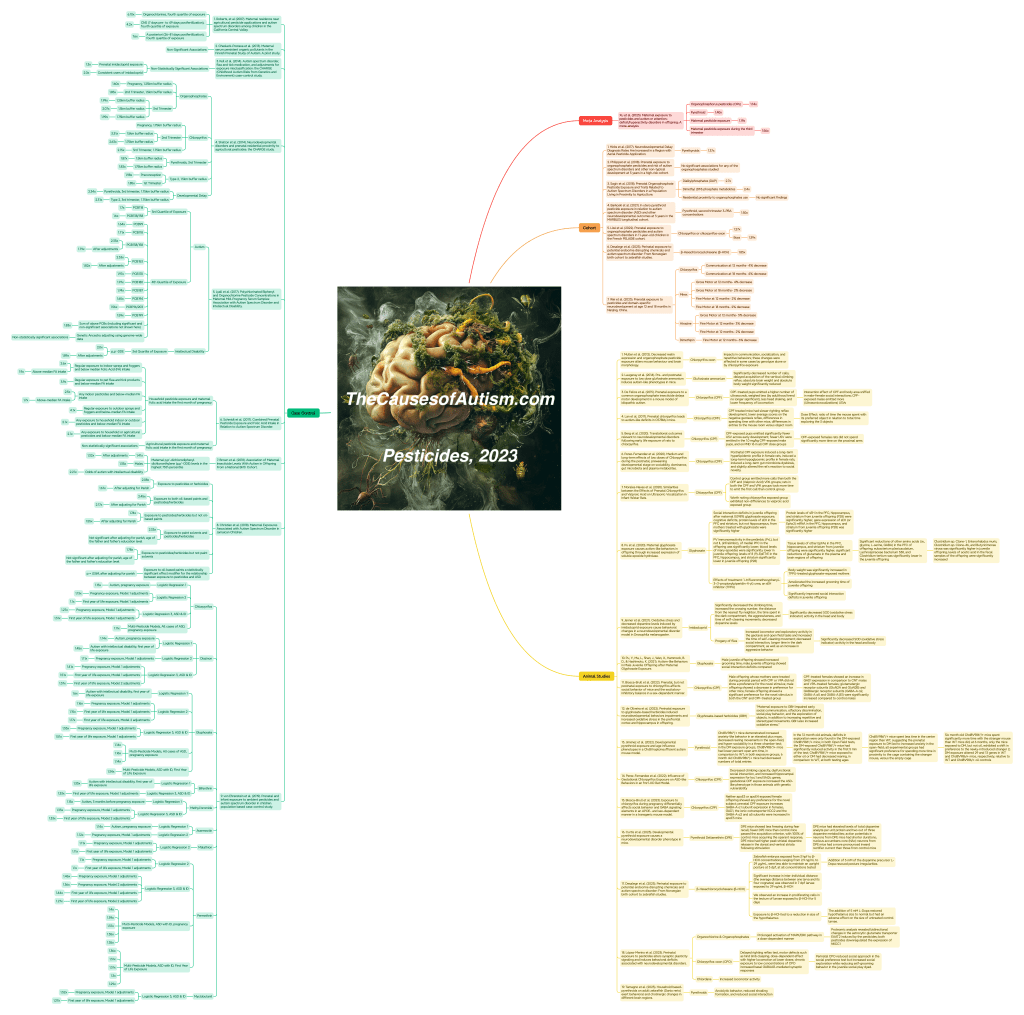
This page shall be updated regularly upon discovery of research that fits the following parameters: research relating to the connection between pesticides and autism.
What is the relationship between pesticides and autism? Does prenatal exposure to pesticides lead to increased autism risk? The following information is purposefully delivered with the intent of providing the public a second opinion regarding autism.
How to interpret the Numbers on this Page
When you browse various pages on toxins, you’ll encounter many studies. There will be a research paper title followed by numbers underneath. What do those numbers mean and why are there so many of them?
Here’s what those numbers signify:
- 1 = No Difference Between Groups: If the number is 1, it means there’s no difference in the likelihood of developing the condition (like autism) between the group exposed to a certain factor and the group that wasn’t.
- Greater than 1 = Increased Likelihood: If the number is greater than 1, it indicates that the group exposed to the factor has a higher likelihood of the condition. For example:
- 1.5: This means the exposed group has 1.5 times the odds or risk of developing autism compared to the non-exposed group. In other words, their risk is 50% higher.
- Less than 1 = Decreased Likelihood or Protective Effect: Numbers less than 1 suggest that exposure might reduce the likelihood of the condition or could even be protective. For instance:
- 0.75: This would mean the exposed group has 25% lower odds or risk compared to those not exposed.
- Multiple Numbers and Analyses:
- You’ll notice multiple numbers because researchers often look at different aspects related to autism, not just diagnosis but also symptoms or associated traits. They might also adjust for other factors (like age, gender, other health conditions) to isolate the effect of the factor they’re studying. This is why you see various analyses:
- Raw Data: Initial numbers before adjustments.
- Adjusted Analyses: Numbers after accounting for other variables to see if the factor still has an effect.
- You’ll notice multiple numbers because researchers often look at different aspects related to autism, not just diagnosis but also symptoms or associated traits. They might also adjust for other factors (like age, gender, other health conditions) to isolate the effect of the factor they’re studying. This is why you see various analyses:
Thus, when you see a number like 1.5, think of it as “the risk or odds of autism for the exposed group is 1.5 times higher compared to those not exposed.” This doesn’t mean everyone exposed will develop autism, but rather, their risk is increased by that factor.
Meta Analyses
- Xu, Y., Yang, X., Chen, D., Xu, Y., Lan, L., Zhao, S., Liu, Q., Snijders, A. M., & Xia, Y. (2023). Maternal exposure to pesticides and autism or attention-deficit/hyperactivity disorders in offspring: A meta-analysis. Chemosphere, 313, 137459. https://doi.org/10.1016/j.chemosphere.2022.137459
- Maternal pesticide exposure– 1.19x Pooled Odds Ratio
- Maternal pesticide exposure during the third trimester- 1.56x Pooled Odds Ratio
- Organophosphates (OPs)- 1.14x Pooled Odds Ratio
- Pyrethroid- 1.40x Pooled Odds Ratio
Cohort Design
- Hicks, S. D., Wang, M., Fry, K., Doraiswamy, V., & Wohlford, E. M. (2017). Neurodevelopmental Delay Diagnosis Rates Are Increased in a Region with Aerial Pesticide Application. Frontiers in pediatrics, 5, 116. https://doi.org/10.3389/fped.2017.00116
- Pyrethroids- 1.37x Pooled Odds Ratio
- Philippat, C., Barkoski, J., Tancredi, D. J., Elms, B., Barr, D. B., Ozonoff, S., Bennett, D. H., & Hertz-Picciotto, I. (2018). Prenatal exposure to organophosphate pesticides and risk of autism spectrum disorders and other non-typical development at 3 years in a high-risk cohort. International journal of hygiene and environmental health, 221(3), 548–555. https://doi.org/10.1016/j.ijheh.2018.02.004
- No significant associations for any of the organophosphate metabolites studied
- Sagiv, S. K., Harris, M. H., Gunier, R. B., Kogut, K. R., Harley, K. G., Deardorff, J., Bradman, A., Holland, N., & Eskenazi, B. (2018). Prenatal Organophosphate Pesticide Exposure and Traits Related to Autism Spectrum Disorders in a Population Living in Proximity to Agriculture. Environmental health perspectives, 126(4), 047012. https://doi.org/10.1289/EHP2580
- Urinary Metabolites
- Dialkylphosphates (DAP)- β = 2.7 CI (0.9, 4.5)
- Dimethyl (DM) phosphate metabolites- β = 2.4, CI (0.8, 4.0)
- Residential proximity to organophosphates use
- No significant findings
- Urinary Metabolites
- Barkoski, J. M., Philippat, C., Tancredi, D., Schmidt, R. J., Ozonoff, S., Barr, D. B., Elms, W., Bennett, D. H., & Hertz-Picciotto, I. (2021). In utero pyrethroid pesticide exposure in relation to autism spectrum disorder (ASD) and other neurodevelopmental outcomes at 3 years in the MARBLES longitudinal cohort. Environmental research, 194, 110495. https://doi.org/10.1016/j.envres.2020.110495
- Non-statistically significant associations for pyrethroid
- Lizé, M., Monfort, C., Rouget, F., Limon, G., Durand, G., Tillaut, H., & Chevrier, C. (2022). Prenatal exposure to organophosphate pesticides and autism spectrum disorders in 11-year-old children in the French PELAGIE cohort. Environmental research, 212(Pt C), 113348. https://doi.org/10.1016/j.envres.2022.113348
- Chlorpyrifos or chlorpyrifos-oxon, All Children- 1.27x Incidence Rate Ratio (IRR)
- Boys- Incidence Rate Ratio (IRR) 1.39x IRR
- Chlorpyrifos or chlorpyrifos-oxon, All Children- 1.27x Incidence Rate Ratio (IRR)
- Desalegn, A. A., van der Ent, W., Lenters, V., Iszatt, N., Stigum, H., Lyche, J. L., Berg, V., Kirstein-Smardzewska, K. J., Esguerra, C. V., & Eggesbø, M. (2023). Perinatal exposure to potential endocrine disrupting chemicals and autism spectrum disorder: From Norwegian birth cohort to zebrafish studies. Environment international, 181, 108271. https://doi.org/10.1016/j.envint.2023.108271
- β-Hexachlorocyclohexane (β-HCH)- 1.83x Adjusted Odds Ratio
- Covariates: parity, smoking during pregnancy, small-for-gestational age, preterm birth, maternal pre-pregnancy body mass index, single mother around perinatal period, and maternal fish intake.
- Wei, H., Zhang, X., Yang, X., Yu, Q., Deng, S., Guan, Q., Chen, D., Zhang, M., Gao, B., Xu, S., & Xia, Y. (2023). Prenatal exposure to pesticides and domain-specific neurodevelopment at age 12 and 18 months in Nanjing, China. Environment international, 173, 107814. https://doi.org/10.1016/j.envint.2023.107814
- Chlorpyrifos
- Communication at 12 months- 4% decrease = 0.96 Risk Ratio
- Communication at 18 months- 4% decrease = 0.96 Risk Ratio
- Mirex
- Gross Motor at 12 months- 4% decrease = 0.96 Risk Ratio
- Gross Motor at 18 months- 2% decrease = 0.98x Risk Ratio
- Fine Motor at 12 months- 2% decrease = 0.98 Risk Ratio
- Fine Motor at 18 months- 2% decrease = 0.98 Risk Ratio
- Atrazine
- Gross Motor at 12 months- 3% decrease = 0.97 Risk Ratio
- Fine Motor at 12 months- 3% decrease = 0.97 Risk Ratio
- Fine Motor at 12 months- 2% decrease = 0.98 Risk Ratio
- Dimethipin
- Fine Motor at 12 months- 6% decrease = 0.94 Risk Ratio
- Chlorpyrifos
Case Control Design
- Roberts, E. M., English, P. B., Grether, J. K., Windham, G. C., Somberg, L., & Wolff, C. (2007). Maternal residence near agricultural pesticide applications and autism spectrum disorders among children in the California Central Valley. Environmental health perspectives, 115(10), 1482–1489. https://doi.org/10.1289/ehp.10168
- Organochlorines, fourth quartile of exposure- 6.10x Odds Ratio
- CNS (7 days pre- to 49 days postfertilization), fourth quartile of exposure- 4.2x Adjusted Odds Ratio
- A posteriori (26–81 days postfertilization), fourth quartile of exposure- 7.6x Adjusted Odds Ratio
- Cheslack-Postava, K., Rantakokko, P. V., Hinkka-Yli-Salomäki, S., Surcel, H. M., McKeague, I. W., Kiviranta, H. A., Sourander, A., & Brown, A. S. (2013). Maternal serum persistent organic pollutants in the Finnish Prenatal Study of Autism: A pilot study. Neurotoxicology and teratology, 38, 1–5. https://doi.org/10.1016/j.ntt.2013.04.001
- Non-Statistically Significant Associations for the following pollutants: HCB, DDE, PCB-118, PCB-138, PCB-153, PCB-156, PCB-170, PCB-180, Total PCBs, TEQdioxin, TEQthyroid, NEQ
- Keil, A. P., Daniels, J. L., & Hertz-Picciotto, I. (2014). Autism spectrum disorder, flea and tick medication, and adjustments for exposure misclassification: the CHARGE (Childhood Autism Risks from Genetics and Environment) case-control study. Environmental health : a global access science source, 13(1), 3. https://doi.org/10.1186/1476-069X-13-3
- Non-Statistically Significant Associations
- Prenatal imidacloprid exposure- 1.3x Odds Ratio (CI: 0.79, 2.2)
- Frequent users of imidacloprid- 2.0x Odds Ratio (CI: 1.0, 3.9)
- Shelton, J. F., Geraghty, E. M., Tancredi, D. J., Delwiche, L. D., Schmidt, R. J., Ritz, B., Hansen, R. L., & Hertz-Picciotto, I. (2014). Neurodevelopmental disorders and prenatal residential proximity to agricultural pesticides: the CHARGE study. Environmental health perspectives, 122(10), 1103–1109. https://doi.org/10.1289/ehp.1307044
- Organophosphates
- Pregnancy, 1.25km buffer radius- 1.60x Adjusted Odds Ratio
- 2nd Trimester, 1.5km buffer radius- 1.85x Adjusted Odds Ratio
- 3rd Trimester
- 1.25km buffer radius- 1.99x Adjusted Odds Ratio
- 1.5km buffer radius- 2.07x Adjusted Odds Ratio
- 1.75km buffer radius- 1.99x Adjusted Odds Ratio
- Chlorpyrifos
- Pregnancy, 1.75km buffer radius- 1.78x Adjusted Odds Ratio
- 2nd Trimester
- 1.5km buffer radius- 3.31x Adjusted Odds Ratio
- 1.75km buffer radius- 2.63x Adjusted Odds Ratio
- 3rd Trimester, 1.75km buffer radius- 2.15x Adjusted Odds Ratio
- Pyrethroids, 3rd Trimester
- 1.5km buffer radius- 1.87x Adjusted Odds Ratio
- 1.75km buffer radius- 1.83x Adjusted Odds Ratio
- Type 2, 1.5km buffer radius
- Preconception- 1.98x Adjusted Odds Ratio
- 1st Trimester- 1.85x Adjusted Odds Ratio
- Developmental Delay
- Pyrethroids, 3rd trimester, 1.75km buffer radius- 2.34x Adjusted Odds Ratio
- Type 2, 3rd trimester, 1.75km buffer radius- 2.31x Adjusted Odds Ratio
- Organophosphates
- Lyall, K., Croen, L. A., Sjödin, A., Yoshida, C. K., Zerbo, O., Kharrazi, M., & Windham, G. C. (2017). Polychlorinated Biphenyl and Organochlorine Pesticide Concentrations in Maternal Mid-Pregnancy Serum Samples: Association with Autism Spectrum Disorder and Intellectual Disability. Environmental health perspectives, 125(3), 474–480. https://doi.org/10.1289/EHP277
- Autism
- 3rd Quartile of Exposure
- PCB118- 1.7x Odds Ratio
- PCB138/158- 1.6x Odds Ratio
- 4th Quartile of Exposure
- PCB99- 1.64x Odds Ratio
- PCB118- 1.71x Odds Ratio
- PCB138/158- 2.33x Odds Ratio
- After adjustments- 1.79x Adjusted Odds Ratio
- PCB153- 2.33x Odds Ratio
- After adjustments- 1.82x Adjusted Odds Ratio
- PCB170- 1.97 Odds Ratio
- PCB180- 1.97x Odds Ratio
- PCB187- 1.74x Odds Ratio
- PCB194- 1.65x Odds Ratio
- PCB196/203- 1.56x Odds Ratio
- PCB199- 1.59x Odds Ratio
- Sum of above PCBs (including significant and non-significant associations not shown here)- 1.83x Odds Ratio
- Genetic Ancestry adjusting using genome-wide data
- Non-statistically significant associations
- 3rd Quartile of Exposure
- Intellectual Disability
- p,p´-DDE, 3rd Quartile- 2.0x Odds Ratio
- After adjustments- 1.89x Adjusted Odds Ratio
- p,p´-DDE, 3rd Quartile- 2.0x Odds Ratio
- Autism
- Schmidt, R. J., Kogan, V., Shelton, J. F., Delwiche, L., Hansen, R. L., Ozonoff, S., Ma, C. C., McCanlies, E. C., Bennett, D. H., Hertz-Picciotto, I., Tancredi, D. J., & Volk, H. E. (2017). Combined Prenatal Pesticide Exposure and Folic Acid Intake in Relation to Autism Spectrum Disorder. Environmental health perspectives, 125(9), 097007. https://doi.org/10.1289/EHP604
- Household pesticide exposure and maternal folic acid intake the first month of pregnancy
- Regular exposure to indoor sprays and foggers and below median Folic Acid (FA) intake- 2.6x Odds Ratio
- Above-median FA intake- 1.9x Odds Ratio
- Regular exposure to pet flea and tick products and below-median FA intake- 3.9x Odds Ratio
- Any indoor pesticides and below-median FA intake- 2.5x Odds Ratio
- Above-median FA intake- 1.7x Odds Ratio
- Regular exposure to outdoor sprays and foggers and below-median FA intake- 4.1x Odds Ratio
- Any exposure to household indoor or outdoor pesticides and below-median FA intake- 2.1x Odds Ratio
- Any exposure to household or agricultural pesticides and below-median FA intake- 2.1x Odds Ratio
- Regular exposure to indoor sprays and foggers and below median Folic Acid (FA) intake- 2.6x Odds Ratio
- Agricultural pesticide exposure and maternal folic acid intake in the first month of pregnancy
- Non-statistically significant associations
- Covariates: home ownership, child’s birth year, and maternal vitamin B6 and vitamin D (natural log) intake during the first month of pregnancy.
- Household pesticide exposure and maternal folic acid intake the first month of pregnancy
- Brown, A. S., Cheslack-Postava, K., Rantakokko, P., Kiviranta, H., Hinkka-Yli-Salomäki, S., McKeague, I. W., Surcel, H. M., & Sourander, A. (2018). Association of Maternal Insecticide Levels With Autism in Offspring From a National Birth Cohort. The American journal of psychiatry, 175(11), 1094–1101. https://doi.org/10.1176/appi.ajp.2018.17101129
- p,p’-dichlorodiphenyl dichloroethylene (p,p′-DDE) highest 75th percentile- 1.41x Odds Ratio
- After adjustments- 1.32x Adjusted Odds Ratio
- Males- 1.35x Odds Ratio
- Odds of autism with intellectual disability- 2.21x Odds Ratio
- No associations were observed for PCB 138 or PCB 153
- Covariates: maternal age, maternal parity, and maternal history of psychiatric disorder
- p,p’-dichlorodiphenyl dichloroethylene (p,p′-DDE) highest 75th percentile- 1.41x Odds Ratio
- Christian, M. A., Samms-Vaughan, M., Lee, M., Bressler, J., Hessabi, M., Grove, M. L., Shakespeare-Pellington, S., Coore Desai, C., Reece, J. A., Loveland, K. A., Boerwinkle, E., & Rahbar, M. H. (2018). Maternal Exposures Associated with Autism Spectrum Disorder in Jamaican Children. Journal of autism and developmental disorders, 48(8), 2766–2778. https://doi.org/10.1007/s10803-018-3537-6
- Exposure to pesticides or herbicides– 2.08x Matched Odds Ratio
- After adjusting for Parish– 1.67x Adjusted Matched Odds Ratio
- Exposure to both oil-based paints and pesticides/herbicides– 2.45x Matched Odds Ratio
- After adjusting for Parish– 2.17x Adjusted Matched Odds Ratio
- Exposure to pesticides/herbicides but not oil-based paints- 1.74x Matched Odds Ratio
- After adjusting for Parish- 1.55x Adjusted Matched Odds Ratio
- Exposure to paint solvents and pesticides/herbicides- 2.33x Matched Odds Ratio
- Not significant after adjusting for parish, age of the father and father’s education level
- Exposure to pesticides/herbicides but not paint solvents- 1.78x Matched Odds Ratio
- Not significant after adjusting for parish, age of the father and father’s education level
- Exposure to oil-based paints a statistically significant effect modifier for the relationship between exposure to pesticides and ASD- p = .0369, after adjusting for parish
- Note: Parish is another term for geographic location of birth
- Exposure to pesticides or herbicides– 2.08x Matched Odds Ratio
- von Ehrenstein, O. S., Ling, C., Cui, X., Cockburn, M., Park, A. S., Yu, F., Wu, J., & Ritz, B. (2019). Prenatal and infant exposure to ambient pesticides and autism spectrum disorder in children: population based case-control study. BMJ (Clinical research ed.), 364, l962. https://doi.org/10.1136/bmj.l962
- Autism (ASD) and Intellectual Disability (ID)
- Logistic Regression 1
- Covariates: year of birth, sex, maternal race or ethnicity, maternal age, maternal education, and NOx (CALINE4) as a marker of traffic related air pollution, and simultaneously for exposures three months before pregnancy (just before or around conception), during pregnancy, and during the first year of life; pesticide exposure defined as ever versus never to specific substance in considered developmental period
- Chlorpyrifos
- Autism, pregnancy exposure- 1.15x Adjusted Odds Ratio
- Diazinon
- Autism, pregnancy exposure- 1.14x Adjusted Odds Ratio
- Autism with intellectual disability, first year of life exposure- 1.45x Adjusted Odds Ratio
- Glyphosate
- Autism with intellectual disability, first year of life exposure- 1.6x Adjusted Odds Ratio
- Bifenthrin
- Autism with intellectual disability, first year of life exposure- 1.33x Adjusted Odds Ratio
- Methyl bromide
- Autism, 3 months before pregnancy exposure- 1.15x Adjusted Odds Ratio
- Avermectin
- Autism, pregnancy exposure- 1.14x Adjusted Odds Ratio
- Logistic Regression 2
- Model 1 covariates: year of birth, sex, maternal race or ethnicity, maternal age, maternal education, and NOx (CALINE4) as a marker of traffic related air pollution; pesticide exposure defined as ever versus never to specific substance in considered developmental period.
- Model 2 covariates: adjusted as model 1; pesticide exposure defined as ever versus never to specific substance in considered developmental period with all considered pesticides in the model.
- Glyphosate
- Pregnancy exposure, Model 1 adjustments- 1.16x Adjusted Odds Ratio
- First year of life exposure, Model 1 adjustments- 1.15x Adjusted Odds Ratio
- First year of life exposure, Model 2 adjustments- 1.17x Adjusted Odds Ratio
- Chlorpyrifos
- Pregnancy, Model 1 adjustments- 1.13x Adjusted Odds Ratio
- First year of life exposure, Model 1 adjustments- 1.1x Adjusted Odds Ratio
- Diazinon
- Pregnancy exposure, Model 1 adjustments- 1.11x Adjusted Odds Ratio
- Malathion
- Pregnancy exposure, Model 1 adjustments- 1.11x Adjusted Odds Ratio
- First year of life exposure, Model 1 adjustments- 1.11x Adjusted Odds Ratio
- Permethrin
- Pregnancy exposure, Model 1 adjustments- 1.1x Adjusted Odds Ratio
- First year of life exposure, Model 1 adjustments- 1.1x Adjusted Odds Ratio
- Avermectin
- Pregnancy exposure, Model 1 adjustments- 1.12x Adjusted Odds Ratio
- Glyphosate
- Logistic Regression 3, Autism Spectrum Disorder (ASD) with Intellectual Disability (ID)
- Model 1 covariates: year of birth, sex, maternal race or ethnicity, maternal age, maternal education, and NOx (CALINE4) as a marker of traffic related air pollution; pesticide exposure defined as ever versus never to specific substance in considered developmental period.
- Model 2 covariates: adjusted as model 1; pesticide exposure defined as ever versus never to specific substance in considered developmental period with all considered pesticides in the model. ‡Glyphosate compounds include glyphosate isopropylamine salt, glyphosate potassium salt, glyphosate monoammonium salt, glyphosate diammonium salt, glyphosate trimesium, and glyphosate dimethylamine salt.
- Glyphosate
- Pregnancy exposure, Model 1 adjustments- 1.33x Adjusted Odds Ratio
- First year of life exposure, Model 1 adjustments- 1.51x Adjusted Odds Ratio
- Chlorpyrifos
- Pregnancy exposure, Model 1 adjustments- 1.27x Adjusted Odds Ratio
- First year of life exposure, Model 1 adjustments- 1.31x Adjusted Odds Ratio
- Diazinon
- Pregnancy exposure, Model 1 adjustments- 1.41x Adjusted Odds Ratio
- First year of life exposure, Model 1 adjustments- 1.51x Adjusted Odds Ratio
- First year of life exposure, Model 2 adjustments- 1.37x Adjusted Odds Ratio
- Permethrin
- Pregnancy exposure, Model 1 adjustments- 1.46x Adjusted Odds Ratio
- Pregnancy exposure, Model 2 adjustments- 1.36x Adjusted Odds Ratio
- First year of life exposure, Model 1 adjustments- 1.44x Adjusted Odds Ratio
- First year of life exposure, Model 2 adjustments- 1.27x Adjusted Odds Ratio
- Bifenthrin
- First year of life exposure, Model 1 adjustments- 1.33x Adjusted Odds Ratio
- Methyl bromide
- Pregnancy exposure, Model 1 adjustments- 1.33x Adjusted Odds Ratio
- First year of life exposure, Model 2 adjustments- 1.33x Adjusted Odds Ratio
- Myclobutanil
- Pregnancy exposure, Model 1 adjustments- 1.32x Adjusted Odds Ratio
- First year of life exposure, Model 1 adjustments- 1.27x Adjusted Odds Ratio
- Multi-Pesticide Models
- All cases of ASD, pregnancy exposure
- Chlorpyrifos- 1.11x Adjusted Odds Ratio
- Glyphosate- 1.14x Adjusted Odds Ratio
- Glyphosate- 1.16x Adjusted Odds Ratio
- Glyphosate- 1.14x Adjusted Odds Ratio
- ASD with ID, pregnancy exposure
- Permethrin- 1.4x Adjusted Odds Ratio
- Permethrin- 1.39x Adjusted Odds Ratio
- Permethrin- 1.37x Adjusted Odds Ratio
- Permethrin- 1.35x Adjusted Odds Ratio
- Permethrin- 1.35x Adjusted Odds Ratio
- ASD with ID, First Year of Life Exposure
- Permethrin- 1.36x Adjusted Odds Ratio
- Permethrin- 1.31x Adjusted Odds Ratio
- Permethrin- 1.31x Adjusted Odds Ratio
- Permethrin- 1.3x Adjusted Odds Ratio
- Permethrin- 1.29x Adjusted Odds Ratio
- Glyphosate- 1.34x Adjusted Odds Ratio
- All cases of ASD, pregnancy exposure
- Román, P., Ruiz-González, C., Rueda-Ruzafa, L., Cardona, D., Requena, M., & Alarcón, R. (2024). Exposure to Environmental Pesticides and the Risk of Autism Spectrum Disorders: A Population-Based Case-Control Study. Medicina (Kaunas, Lithuania), 60(3), 479. https://doi.org/10.3390/medicina60030479
- Data locale: Andalusia, Spain
- Study period: 2000-2021
- Autism rate per 100
- Total- 1.34x Odds Ratio
- Males- 1.42x Odds Ratio
- Females- 1.17x Odds Ratio
- Stepwise multiple logistic regression, adjusted for geographical areas (high and low pesticides) and gender
- Areas of high pesticide use- 1.52x Odds Ratio
- Male- 2.41x
Animal Studies
- Mullen, B. R., Khialeeva, E., Hoffman, D. B., Ghiani, C. A., & Carpenter, E. M. (2012). Decreased reelin expression and organophosphate pesticide exposure alters mouse behaviour and brain morphology. ASN neuro, 5(1), e00106. https://doi.org/10.1042/AN20120060
- Impacts in communication, socialization, and repetitive behaviors; these changes were affected in some cases by genotype alone or by organophosphate exposure.
- Laugeray, A., Herzine, A., Perche, O., Hébert, B., Aguillon-Naury, M., Richard, O., Menuet, A., Mazaud-Guittot, S., Lesné, L., Briault, S., Jegou, B., Pichon, J., Montécot-Dubourg, C., & Mortaud, S. (2014). Pre- and postnatal exposure to low dose glufosinate ammonium induces autism-like phenotypes in mice. Frontiers in behavioral neuroscience, 8, 390. https://doi.org/10.3389/fnbeh.2014.00390
- Glufosinate ammonium (GLA)
- Significantly decreased number of calls
- Delayed acquisition of the vertical climbing reflex
- Absolute brain weight and absolute body weight significantly reduced
- Glufosinate ammonium (GLA)
- De Felice, A., Scattoni, M. L., Ricceri, L., & Calamandrei, G. (2015). Prenatal exposure to a common organophosphate insecticide delays motor development in a mouse model of idiopathic autism. PloS one, 10(3), e0121663. https://doi.org/10.1371/journal.pone.0121663
- Chlorpyrifos (CPF)
- CPF-treated pups emitted a higher number of ultrasounds
- CPF-treated pups weighed less (by adulthood trend no longer significant)
- CPF pups less head shaking
- CPF pups showing lower frequency of locomotion
- Interaction effect of CPF and body area sniffed in male-female social interactions
- CPF-exposed males emitted more (Ultrasonicvocalizations) USVs
- Chlorpyrifos (CPF)
- Lan, A., Kalimian, M., Amram, B., & Kofman, O. (2017). Prenatal chlorpyrifos leads to autism-like deficits in C57Bl6/J mice. Environmental health: a global access science source, 16(1), 43. https://doi.org/10.1186/s12940-017-0251-3
- Chlorpyrifos (CPF)
- CPF treated mice had slower righting reflex development
- CPF-treated mice had lower average scores on the negative geotaxis reflex
- CPF-treated mice showed differences in spending time with other mice
- CPF-treated mice showed differences in entries to the mouse room versus object room
- Dose Effect: ratio of time the mouse spent with its preferred object in relation to total time exploring the 3 objects
- Berg, E. L., Ching, T. M., Bruun, D. A., Rivera, J. K., Careaga, M., Ellegood, J., Lerch, J. P., Wöhr, M., Lein, P. J., & Silverman, J. L. (2020). Translational outcomes relevant to neurodevelopmental disorders following early life exposure of rats to chlorpyrifos. Journal of neurodevelopmental disorders, 12(1), 40. https://doi.org/10.1186/s11689-020-09342-1
- Chlorpyrifos (CPF)
- CPF-exposed pups emitted significantly fewer USV across early development
- Fewer USV were emitted in the 1.0 mg/kg CPF-exposed male pups, and on PND 16 in all CPF dose groups
- CPF-exposed females rats did not spend significantly more time on the proximal arms
- Perez-Fernandez, C., Morales-Navas, M., Aguilera-Sáez, L. M., Abreu, A. C., Guardia-Escote, L., Fernández, I., Garrido-Cárdenas, J. A., Colomina, M. T., Giménez, E., & Sánchez-Santed, F. (2020). Medium and long-term effects of low doses of Chlorpyrifos during the postnatal, preweaning developmental stage on sociability, dominance, gut microbiota and plasma metabolites. Environmental research, 184, 109341. https://doi.org/10.1016/j.envres.2020.109341
- Chlorpyrifos (CPF)
- Postnatal CPF exposure induced a long-term hyperlipidemic profile in female rats.
- Postnatal CPF exposure induced a long-term hypoglycemic profile in female rats.
- Postnatal CPF exposure induced a long-term gut microbiota dysbiosis.
- Postnatal CPF exposure slightly altered the rat’s reaction to social novelty.
- Morales-Navas, M., Castaño-Castaño, S., Pérez-Fernández, C., Sánchez-Gil, A., Teresa Colomina, M., Leinekugel, X., & Sánchez-Santed, F. (2020). Similarities between the Effects of Prenatal Chlorpyrifos and Valproic Acid on Ultrasonic Vocalization in Infant Wistar Rats. International journal of environmental research and public health, 17(17), 6376. https://doi.org/10.3390/ijerph17176376
- Chlorpyrifos (CPF)
- Control group emitted more calls than both the CPF and (Valproic Acid) VPA groups
- Rats in both the CPF and VPA groups took more time to emit the first call than control group
- Pu, Y., Yang, J., Chang, L., Qu, Y., Wang, S., Zhang, K., Xiong, Z., Zhang, J., Tan, Y., Wang, X., Fujita, Y., Ishima, T., Wang, D., Hwang, S. H., Hammock, B. D., & Hashimoto, K. (2020). Maternal glyphosate exposure causes autism-like behaviors in offspring through increased expression of soluble epoxide hydrolase. Proceedings of the National Academy of Sciences of the United States of America, 117(21), 11753–11759. https://doi.org/10.1073/pnas.1922287117
- Social interaction deficits in juvenile offspring after maternal 0.098% glyphosate exposure.
- Juvenile offspring showed social interaction deficits.
- Offspring showed cognitive deficits.
- Protein levels of sEH in the PFC and striatum, but not hippocampus, from mothers treated with glyphosate were significantly higher.
- Protein levels of sEH in the PFC, hippocampus, and striatum from juvenile offspring (P28) were significantly higher.
- Gene expression of sEH (or Ephx2) mRNA in the PFC, hippocampus, and striatum from juvenile offspring (P28) was significantly higher.
- PV immunoreactivity in the prelimbic (PrL), but not IL (infralimbic), of medial PFC in the offspring was significantly lower.
- Blood levels of many epoxides were significantly lower in juvenile offspring
- Levels of 8 (9)-EpETrE in the PFC, hippocampus, and striatum significantly lower in juvenile offspring (P28).
- Tissue levels of other EpFAs in the PFC, hippocampus, and striatum from juvenile offspring were significantly higher.
- Significant reductions of glutamate in the plasma and brain regions of offspring.
- Significant reductions of other amino acids (i.e., glycine, L-serine, GABA) in the PFC of offspring.
- Eubacterium plexicaudatum, Lachnospiraceae bacterium 538, and Clostridium tertium was significantly lower in the juvenile offspring.
- Clostridium sp. Clone-1, Enterorhabdus muris, Clostridium sp. Clone-46, and Butyricimonas virosa was significantly higher in juvenile offspring.
- Levels of acetic acid in the fecal samples of the offspring were significantly increased.
- Effects of treatment: 1-trifluoromethoxyphenyl-3-(1-propionylpiperidin-4-yl) urea, an sEH inhibitor (TPPU)
- Body weight was significantly increased in TPPU-treated glyphosate-exposed mothers
- Ameliorated the increased grooming time of juvenile offspring
- Significantly improved social interaction deficits in juvenile offspring
- Janner, D. E., Gomes, N. S., Poetini, M. R., Poleto, K. H., Musachio, E. A. S., de Almeida, F. P., de Matos Amador, E. C., Reginaldo, J. C., Ramborger, B. P., Roehrs, R., Prigol, M., & Guerra, G. P. (2021). Oxidative stress and decreased dopamine levels induced by imidacloprid exposure cause behavioral changes in a neurodevelopmental disorder model in Drosophila melanogaster. Neurotoxicology, 85, 79–89. https://doi.org/10.1016/j.neuro.2021.05.006
- Imidacloprid
- Significantly decreased the climbing time, increased the crossing number, the distance from the nearest fly neighbor, the time spent in the dark compartment, the aggressiveness, and time of self-cleaning movements.
- Decreased dopamine levels
- Significantly decreased SOD (oxidative stress indicator) activity in the head and body
- Progeny of flies
- Increased locomotor and exploratory activity in the geotaxis and open field tasks and increased the time of self-cleaning movement; decreased social interaction, longer time in the dark compartment, as well as an increase in aggressive behavior.
- Significantly decreased SOD (oxidative stress indicator) activity in the head and body
- Imidacloprid
- Pu, Y., Ma, L., Shan, J., Wan, X., Hammock, B. D., & Hashimoto, K. (2021). Autism-like Behaviors in Male Juvenile Offspring after Maternal Glyphosate Exposure. Clinical psychopharmacology and neuroscience : the official scientific journal of the Korean College of Neuropsychopharmacology, 19(3), 554–558. https://doi.org/10.9758/cpn.2021.19.3.554
- Glyphosate
- Male juvenile offspring showed increased grooming time
- Male juvenile offspring showed social interaction deficits
- Glyphosate
- Biosca-Brull, J., Guardia-Escote, L., Blanco, J., Basaure, P., Cabré, M., Sánchez-Santed, F., Domingo, J. L., & Colomina, M. T. (2022). Prenatal, but not postnatal exposure to chlorpyrifos affects social behavior of mice and the excitatory-inhibitory balance in a sex-dependent manner. Food and chemical toxicology: an international journal published for the British Industrial Biological Research Association, 169, 113423. https://doi.org/10.1016/j.fct.2022.113423
- Chlorpyrifos (CPF)
- Male offspring whose mothers were treated during prenatal period with CPF or VPA did not show a preference for the novel stimulus.
- Male offspring showed a decrease in preference for other mice
- Female offspring showed a significant preference for the novel stimulus in both the CNT and CPF-treated group
- CPF-treated females showed an increase in GAD1 expression in comparison to CNT males and VPA-treated females
- Glutamatergic receptor subunits (GluN2A and GluN2B) and GABAergic receptor subunits (GABA-A α2, GABA-A α5 and GABA-A β3) were significantly increased compared to control males
- de Oliveira, M. A. L., Rojas, V. C. T., de Sá, J. C., de Novais, C. O., Silva, M. S., de Almeida Paula, H. A., Kirsten, T. B., Bernardi, M. M., Pinheiro, L. C., Giusti-Paiva, A., & Vilela, F. C. (2022). Perinatal exposure to glyphosate-based herbicides induced neurodevelopmental behaviors impairments and increased oxidative stress in the prefrontal cortex and hippocampus in offspring. International journal of developmental neuroscience : the official journal of the International Society for Developmental Neuroscience, 82(6), 528–538. https://doi.org/10.1002/jdn.10207
- Glyphosate Based Herbicide (GBH)
- “Maternal exposure to GBH impaired early social communication, olfactory discrimination, social play behavior, and the exploration of objects, in addition to increasing repetitive and stereotyped movements. GBH also increased oxidative stress.“
- Jiménez, J. A., Simon, J. M., Hu, W., Moy, S. S., Harper, K. M., Liu, C. W., Lu, K., & Zylka, M. J. (2022). Developmental pyrethroid exposure and age influence phenotypes in a Chd8 haploinsufficient autism mouse model. Scientific reports, 12(1), 5555. https://doi.org/10.1038/s41598-022-09533-x
- Pyrethroid
- Chd8V986*/+ mice demonstrated several behavioral phenotypes, including increased anxiety-like behavior in an elevated plus maze, decreased rearing movements in the open-field, and hyper-sociability in a three-chamber test
- In the DM exposure groups, Chd8V986*/+ mice had lower percent open arm time, in comparison to WT
- In both exposure groups, 6 month old Chd8V986*/+ mice had decreased numbers of total entries
- In the 12 month old animals, deficits in exploration were only found in the DM-exposed Chd8V986*/+ mice
- In both Open Field tests, the DM-exposed Chd8V986*/+ mice had significantly reduced activity in the first 5 min of the test
- Chd8V986*/+ mice exposed to either oil or DM had decreased rearing, in comparison to WT, at both testing ages
- Chd8V986*/+ mice spent less time in the center region than WT, suggesting the prenatal exposure to DM led to increased anxiety in the open-field.
- All experimental groups had significant preference for spending more time in proximity to the cage containing the stranger mouse, versus the empty cage
- Six month old Chd8V986*/+ mice spent significantly more time with the stranger mouse than WT mice did
- At 6 months, only the mice exposed to DM, but not oil, exhibited a shift in preference to the newly-introduced stranger 2
- DM exposure altered 29 and 13 genes in WT and Chd8V986/+ mice, respectively, relative to WT and Chd8V986/+ oil controls
- The study detected 229 DEGs in PND 5 Chd8V986*/+ mice compared to WT control mice
- An increase in expression of the mature oligodendrocyte marker, Apc, but decreased expression of myelin-related genes, Cnp, Mag, and Pdgfra
- Perez-Fernandez, C., Matamala Montoya, M., Morales-Navas, M., Guardia-Escote, L., Cabré, M., Colomina, M. T., Giménez, E., & Sánchez-Santed, F. (2022). Influence of Gestational Chlorpyrifos Exposure on ASD-like Behaviors in an fmr1-KO Rat Model. Molecular neurobiology, 59(9), 5835–5855. https://doi.org/10.1007/s12035-022-02933-0
- Decreased climbing capacity, dysfunctional social interaction, and increased hippocampal expression for kcc1 and 5ht2c genes.
- Gestational CPF exposure increased the ASD-like phenotype in animals with genetic vulnerability
- Biosca-Brull, J., Guardia-Escote, L., Basaure, P., Cabré, M., Blanco, J., Pérez-Fernández, C., Sánchez-Santed, F., Domingo, J. L., & Colomina, M. T. (2023). Exposure to chlorpyrifos during pregnancy differentially affects social behavior and GABA signaling elements in an APOE- and sex-dependent manner in a transgenic mouse model. Environmental research, 224, 115461. https://doi.org/10.1016/j.envres.2023.115461
- Chlorpyrifos
- Neither apoE3 or apoE4 exposed female offspring showed any preference for the novel subject
- Prenatal CPF exposure increases GABA-A α1 subunit expression in females
- GAD1, the ionic cotransporter KCC2 and the GABA-A α2 and α5 subunits were increased in apoE3 mice
- Curtis, M. A., Dhamsania, R. K., Branco, R. C., Guo, J. D., Creeden, J., Neifer, K. L., Black, C. A., Winokur, E. J., Andari, E., Dias, B. G., Liu, R. C., Gourley, S. L., Miller, G. W., & Burkett, J. P. (2023). Developmental pyrethroid exposure causes a neurodevelopmental disorder phenotype in mice. PNAS nexus, 2(4), pgad085. https://doi.org/10.1093/pnasnexus/pgad085
- Pyrethroid Deltamethrin (DPE)
- DPE mice showed less freezing during fear recall
- Fewer DPE mice than control mice passed the acquisition criterion, with 100% of control mice acquiring the operant response
- DPE mice had higher peak striatal dopamine release in the dorsal and ventral striata following stimulation
- DPE mice had elevated levels of total dopamine analyte per unit protein and two out of three dopamine metabolites
- Action potentials in neurons from DPE mice had shorter durations
- Nucleus accumbens core (NAc) neurons from DPE mice had a more pronounced inward rectifier current than those from control mice
- Desalegn, A. A., van der Ent, W., Lenters, V., Iszatt, N., Stigum, H., Lyche, J. L., Berg, V., Kirstein-Smardzewska, K. J., Esguerra, C. V., & Eggesbø, M. (2023). Perinatal exposure to potential endocrine disrupting chemicals and autism spectrum disorder: From Norwegian birth cohort to zebrafish studies. Environment international, 181, 108271. https://doi.org/10.1016/j.envint.2023.108271
- β-Hexachlorocyclohexane (β-HCH)
- Zebrafish embryos exposed from 3 hpf to β-HCH concentrations ranging from 2.9 ng/mL to 29 μg/mL, were less able to maintain an upright posture at 3 dpf, at all concentrations tested
- Addition of 5 mM of the dopamine precursor L-Dopa rescued posture irregularities.
- Significant increase in inter-individual distance (the average distance between one larva and its four cognates) was observed in 7 dpf larvae exposed to 29 ng/mL β-HCH
- We observed an increase in proliferating cells in the tectum of larvae exposed to β-HCH for 5 days
- Exposure to β-HCH led to a reduction in size of the hypothalamus
- The addition of 5 mM L-Dopa restored hypothalamus size to normal but had an adverse effect on the size of untreated control larvae.
- López-Merino, E., Cuartero, M. I., Esteban, J. A., & Briz, V. (2023). Perinatal exposure to pesticides alters synaptic plasticity signaling and induces behavioral deficits associated with neurodevelopmental disorders. Cell biology and toxicology, 39(5), 2089–2111. https://doi.org/10.1007/s10565-022-09697-2
- Organochlorine & Organophosphates
- Prolonged activation of MAPK/ERK pathway in a dose-dependent manner
- Chlorpyrifos-oxon (CPO)
- Delayed righting reflex test, motor defects such as hind limb clasping
- Dose-dependent effect with higher locomotion at lower doses
- Chronic exposure to low concentrations of CPO increased basal GABAAR-mediated synaptic responses
- Delayed righting reflex test, motor defects such as hind limb clasping
- Chlordane increased locomotor activity
- Proteomic analysis revealed bidirectional changes in the astrocytic glutamate transporter EAAT2 induced by the pesticides; both pesticides downregulated the expression of NKCC1
- Organochlorine & Organophosphates
- Tamagno, W. A., Alves, C., Pompermaier, A., Amaral, F. U. Í., Freddo, N., Soares, S. M., Gonçalves, T. S., Siqueira, L., Fortuna, M., Dos Santos, H. C., Gorrosterrazú, A., Reolon, G. K., & Barcellos, L. J. G. (2023). Household based-pyrethroids on adult zebrafish (Danio rerio) exert behavioral and cholinergic changes in different brain regions. Neurotoxicology, 96, 19–27. https://doi.org/10.1016/j.neuro.2023.02.011
- Pyrethroids
- Anxiolytic behavior, reduced shoaling formation, and reduced social interaction
Literature Reviews
- Cimino, A. M., Boyles, A. L., Thayer, K. A., & Perry, M. J. (2017). Effects of Neonicotinoid Pesticide Exposure on Human Health: A Systematic Review. Environmental health perspectives, 125(2), 155–162. https://doi.org/10.1289/EHP515
- Ongono, J. S., Béranger, R., Baghdadli, A., & Mortamais, M. (2020). Pesticides used in Europe and autism spectrum disorder risk: can novel exposure hypotheses be formulated beyond organophosphates, organochlorines, pyrethroids and carbamates? – A systematic review. Environmental research, 187, 109646. https://doi.org/10.1016/j.envres.2020.109646
- Maleki, M., Noorimotlagh, Z., Mirzaee, S. A., Jaafarzadeh, N., Martinez, S. S., Rahim, F., & Kaffashian, M. (2022). An updated systematic review on the maternal exposure to environmental pesticides and involved mechanisms of autism spectrum disorder (ASD) progression risk in children. Reviews on environmental health, 38(4), 727–740. https://doi.org/10.1515/reveh-2022-0092
- Abou Diwan, M., Lahimer, M., Bach, V., Gosselet, F., Khorsi-Cauet, H., & Candela, P. (2023). Impact of Pesticide Residues on the Gut-Microbiota-Blood-Brain Barrier Axis: A Narrative Review. International journal of molecular sciences, 24(7), 6147. https://doi.org/10.3390/ijms24076147
- Yang, Y., Zhou, S., Xing, Y., Yang, G., & You, M. (2023). Impact of pesticides exposure during neurodevelopmental period on autism spectrum disorders – A focus on gut microbiota. Ecotoxicology and environmental safety, 260, 115079. https://doi.org/10.1016/j.ecoenv.2023.115079
2024 Lineup
- Palmer R. F. (2024). An Exploratory Investigation of Organic Chemicals Detected in Baby Teeth: Differences in Children with and without Autism. Journal of xenobiotics, 14(1), 404–415. https://doi.org/10.3390/jox14010025
- Chemicals (μg/g) that statistically differ between Autism cases and controls
- Insecticides
- Homosalate- Min/Max level was 0.67/57.12 in the Autism group while the Control group was 0.00/11.11
- To identify the most toxic set of pesticides, the Pesticide Action Network (PAN) created the term PAN Bad Actor. These pesticides are at least a known or probable carcinogen, a reproductive or developmental toxicants, a neurotoxic cholinesterase inhibitor, a known groundwater contaminant, or a pesticide with high acute toxicity.
- PAN Bad Actors
- Benzophenone- Min/Max level was 1.94/40.46 in the Autism group while the Control group was 0.46/9.13
- Phenol, 4-(1,1-dimethylpropyl)- Min/Max level was 0.00/12.24 in the Autism group while the Control group was 0.00/7.02
- Phenol, 4-chloro-3-methyl- Min/Max level was 0.00/22.41 in the Autism group while the Control group was 0.00/0.00
- Dibutyl phthalate- Min/Max level was 30.49/1966.46 in the Autism group while the Control group was 4.53/244.78.
Important Articles on Pesticides
- Take Action: Pesticide Manufacturers Ask States To Shield Them from Lawsuits by Those Harmed
- ICAN Obtains Records Showing the U.S. Military Sprays Toxic Pesticides in U.S. Residential Areas.
- “Thus, the risk of pesticide ingestion from fruits cannot be avoided by simple washing other than peeling.”
- Lin, Z., Fu, X., Zheng, K., Han, S., Chen, C., & Ye, D. (2024). Cellulose Surface Nanoengineering for Visualizing Food Safety. Nano letters, 10.1021/acs.nanolett.4c01513. Advance online publication. https://doi.org/10.1021/acs.nanolett.4c01513
- Over 60 Biomarkers of Pollutants and Pesticides Found in Hair Analyses of French Children
- 10 Times as Much of This Toxic Pesticide Could End Up on Your Tomatoes and Celery Under a New EPA Proposal
- ‘Shocking’: Heavy Metals, Nearly 50 Pesticides Detected in School Lunches
- Flooding Transports Pesticides from Streams to Soil and Plants, Threatens Terrestrial Food Webs
- Pesticides found in 80% of air samples from California farm communities
 The Causes of Autism