

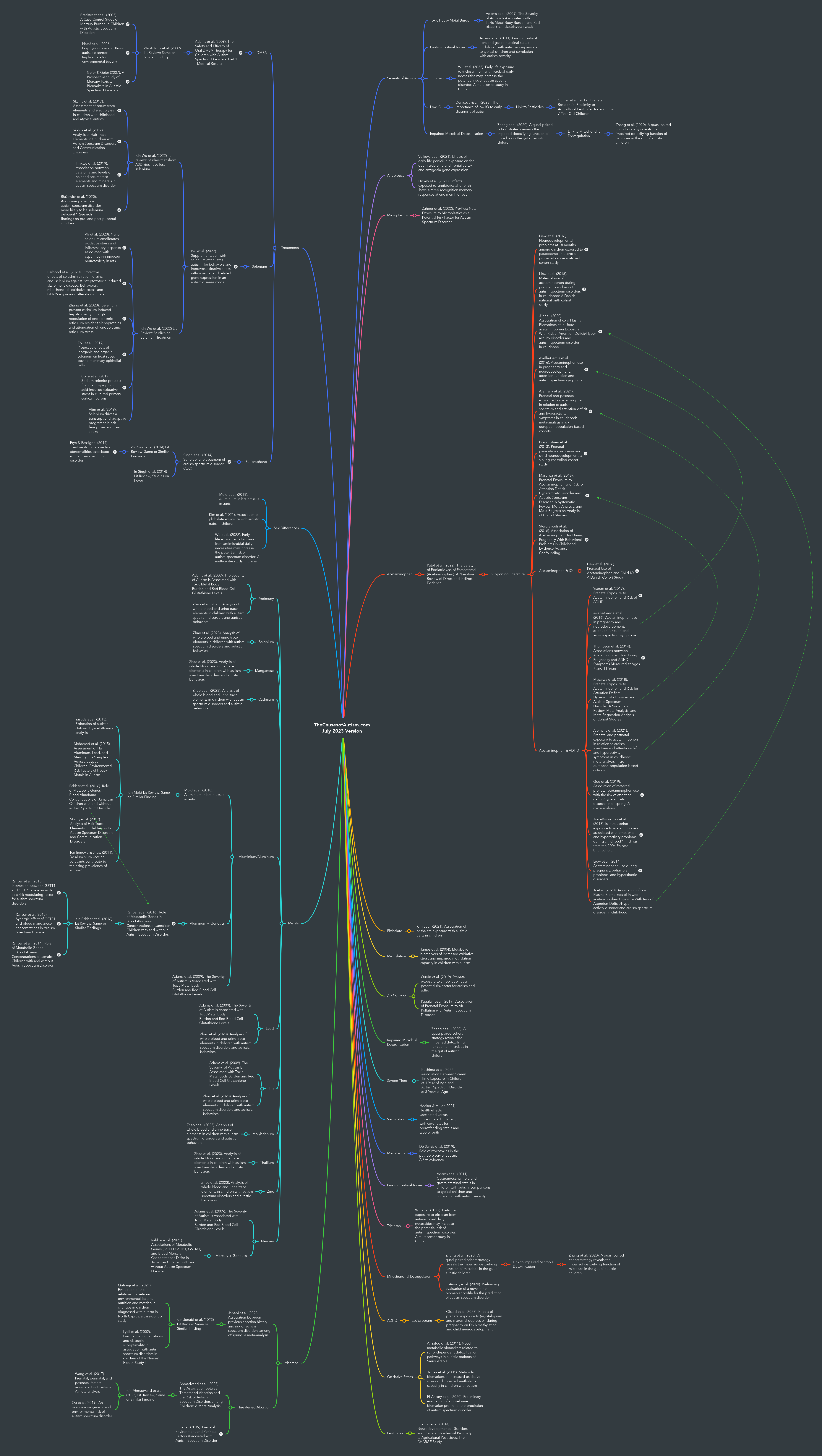
I’m pleased to announce the restructuring of this library that shall include separate and individual pages with literature reviews for factors associated with autism.
This library originally began with a thought: spread awareness about various environmental factors associated with autism. Pesticides, valproate, triclosan, heavy metals, etc.
However, the library was initially begun under the belief that it was necessary to conduct a one-by-one summary of each individual study in order to present the findings to the public in an easily-digestible way. It was an incredibly time consuming endeavor, even with the use of artificial intelligence (AI) for assistance.
Having long abandoned using AI in reviewing studies for this library, coupled with the development of newfound passion for reading and understanding autism literature, I’m more than pleased to provide the public with the addition of the Pesticides section of the library with a corresponding mindmap (did I mention I’m obsessed with mindmaps and making sense of the craziness?).
Admittedly, appearance of the quality of the mindmap can vary depending on browser, application, or device, and this is something I’ve yet to figure out. The browser version of X (formerly known as Twitter) is one method that appears to be consistently useful for zooming in and reading small text. Nevertheless, the entirety of the pesticide-autism literature can be found at the link previously provided. Should I happen to find additional studies that were published in 2023 or prior that I missed, I shall update the page and the mindmap. The 2024 version of the Pesticide-Autism mindmap, which will be published next year, shall include studies published this year in 2024.
What does the conglomeration of the Pesticides-Autism literature in one place mean?
It means we are able to better understand the etiology of autism using science.
What is true autism awareness?
Are we spreading true autism awareness without consideration of environmental factors that are connected to autism?
How can awareness about a disease or ailment be considered if we do not address the etiology of it?
No doubt there are many socio-psychological topics to consider when raising public awareness regarding environmental factors associated with autism, and while this library may at times address those factors to address better public assimilation of this information, it is not the focus of this library.
The focus of this library is to draw awareness to toxins in our environment that may lead to autism symptoms, regardless of age and regardless of whether or not one meets diagnostic criteria. Thus, a conservative approach to autism is taken that does not assume a “safety zone” due to age. While indeed the present literature appears to indicate that the most vulnerable period for exposure to toxins is the prenatal period, it goes without saying that prolonged exposure to a toxin such as organophosphates, even while in adulthood, is detrimental to health.
I thank all of those who follow this work, and who make the effort to educate themselves on this literature to spread ‘true autism awareness’ -whatever the term may mean to you.
Best of luck.
Autism Librarian
 The Causes of Autism