


This section of the library shall be dedicated to commentaries on Children’s Health Defense and Hubermanlab content. Included below is not a summary of the content (I’ll leave that for you to check out), but rather [and] my comments in terms of psychology, health, and human behavior. Whenever possible, I draw connections to autism as well. Most of my comments originally appear on Twitter/X, so be sure to follow on there.
Fluoride On Trial: The Censored Science on Fluoride and Your Health
Tools to Enhance Working Memory & Attention
Given Dr. Huberman’s latest podcast episode on working memory, and given working memory’s relationship to IQ, it felt appropriate to double up on my commentaries this week within the context of neurodevelopment and fluoride.
I usually don’t provide summary of content in these commentaries, but I believe a revisiting of key points in the film by CHD is quite warranted.
National Toxicology Program Review on Fluoride and Intelligence Scores
- 72 studies were identified by the National Toxicology Program (NTP); their conclusion was that high fluoride exposure was associated with lower IQ in children, and they drew this conclusion based on all of the covariates adjusted for in the literature. NTP were set to publish the report.
- NTP were set to publish the report, but the CDC found out and began taking steps to intervene -this was revealed as a result of FOIA requests.
- Based on information obtained from FOIA requests, it was discovered that the NTP researchers pushed back against the CDC and attempted to have their findings released.
- Admiral Levine requests a review and clearance of the monograph before it is released. “There is no way this is going out on May 18th.”
- Emails from CDC confirm that Levine put the report on hold until further notice.” Under deposition, ASTDD Executive Director Chris Wood confirms the CDC told her Rachel Levine made the decision. “It could’ve been the CDC.” Librarian’s note: Chris Wood seemed terrified during the deposition.
- Scientific Director Brian Barriage at NTP, as well as Dr. Birnbaum, confirmed political pressure on NTP as a consequence of the findings.
History of Fluoridation (also discussed in the 1 hour film)

- H Trendly Dean, the Father of Fluoridation, himself had concerns about adding fluoride in water. They had found arthritic symptoms and pain associations since the 1930. He and fellow researchers never reported these and similar findings to the public or the scientific community.
- Fluoride is actually used in the creation of bombs. This dark history of fluoride largely been ignored.
- Dr. Harold Hodge, who was one of the first proponents of water fluoridation, was chief toxicologist for Manhattan project. He was very involved with uninformed consent experimentation on humans. “Human products” was the term he often used. He and fellow researchers experimented injecting people with uranium and plutonium.
- Declassified files show Dr. Harold Hodge exposed fluoride to humans with kidney disease. Those with kidney disease couldn’t excrete fluoride; the experiment was repeated on rabbits with kidney disease.
- In the 1950s, Dr. Harold Hodge wrote in journal of American Dental Association the complete opposite of what he was finding privately. In other words, he did not inform the public regarding the possible harms of fluoride.
- The early foundation upon fluoridation of water was based on lies to begin with and the covering up of scientific data. Neither ones brain, bones, nor thyroid need fluoride. It serves no function.
- Under deposition, Former EPA scientist Dr. William Hirzy states fluoride isn’t needed in water to decrease rates of cavities.
Thoughts on the Film
Given some previous awareness on the impact of exposure to fluoride on intelligence thanks to various alternative media sources (though I was not yet deeply familiar with the literature itself), the most shocking aspect of the film was the discussion around the history of fluoridation. Unbelievable. Now we can go around telling everyone one of the founding fathers of fluoridation was involved in the Manhattan project and in the inhumane experimentation on humans without informed consent, and the other one (H Trendly Dean) had concerns about fluoridation from the beginning. Worse, neither of them reported private research findings on the negative effects of fluoridation on health to the public.

I must laugh a bit cynically at this information regarding the very shaky foundations of fluoridation and recall with certain fondness a meme I keep seeing appear on the internet that speaks about people’s unwillingness to accept something as true unless its spoken of in mainstream media. I think this comes from an inherent innocence most people have, especially good people who mean no harm to others. The less likely you are to harm others, maybe the less likely you are to believe in the capacity for others to be so virulently callous. Although, this fluoridation situation is no conspiracy theory -even if some may still treat it as such- many may continue to doubt unless the scientific evidence is put in front of them, which is quite the number of studies at this point.
My hope rests in the ability for people to 1. Retain their love and compassion for humanity while 2. Accepting some individuals have the capacity for utter disregard for life itself. This may seem a bit extreme considering the issue of water fluoridation, but I collectively hold in mind many, many other issues as well -not just this one.
The National Toxicology Program (NTP) Monograph
In reading sections of the NTP Monograph on Fluoride, it is evident that an extensive analysis has been conducted to come to meaningful conclusions regarding the impact of fluoride on intelligence. On one hand, the impact of fluoride on IQ seems rather obvious at this point given that 18 of the 19 high quality studies reviewed in the report found an association between fluoride and IQ scores, while 46 of the 53 low quality studies reported similar findings -the paper is quite extensive, and the red comments on the sidelines speak volumes of the attempts to protect water fluoridation.
One comment read as follows:
Recommendation: [Redacted name] requests NTP include a statement in the systematic review abstract and full text, as well as the meta-analysis, like that found in the 2020 draft monograph: “When focusing on findings from studies with exposures in ranges typically found in drinking water in the United States (0.7 mg/L for optimally fluoridated community water systems) that can be evaluated for dose response, effects on cognitive neurodevelopment are inconsistent, and therefore unclear.” (pg 13)
What this comment from an unknown reviewer of the monograph suggests is that the NTP report differentiate between the level of exposure to fluoride that is provided in drinking water versus the amount that people are cumulatively exposed to from multiple sources -a subtle distinction and surely an attempt to remove liability for harms caused to people from high exposure to fluoride beyond normally obtained in drinking water. In other words, it paves the way for an argument such as “hey, it’s not our fault if people are being overexposed to fluoride. The amount we put in drinking water isn’t having negative impacts on neurodevelopment, and we’re going to continue putting it in drinking water.”
Another comment requests additional sentences that state the benefits of fluoride in drinking water:
“It might be beneficial to begin the abstract and background with the pervasive use of fluoride in drinking water followed by a brief statement of the benefits. The benefits of fluoride in water has not been articulated. The benefits only need a sentence or two. The background appears to be more of a justification for the report rather than a true background of the evidence leading to the study/report.” (pg 15)
However, it should be noted that under deposition, (as shown in the CHD film) Dr. William Hirzy Former EPA scientist admitted the removal of fluoride wouldn’t result in a reduction of cavities -this entirely undermines the need to put fluoride in any water supply.
In spite of comments on the sides of the monograph, which in my view, appear to be subtle attempts to “water down” the findings of analysis, the conclusions of the National Toxicology Program’s analysis are quite remarkable. The final remarks in the 2022 draft constitute a finality to the analysis of the relationship between fluoride and IQ in children.
“This review finds, with moderate confidence, that fluoride exposure is associated with lower IQ in children. The association between higher fluoride exposure and lower IQ in children was consistent across different study populations, study locations, study quality/risk-of-bias determinations, study designs, exposure measures, and types of exposure data (group-level and individual-level).” (page 745, 2022 prepublication draft)
In both the 2020 and 2022 drafts, discussions regarding the generalization of findings to the United States (oddly enough, none of the studies evaluating IQ were conducted in the United States -no funding for such studies, eh?-), the authors also commented on the multiple sources of fluoride children are exposed to. This point important to consider when evaluating the necessity to place fluoride in drinking water when multiple sources of fluoride are already exposing people to its effects -sometimes without our consent. If one factor to consider regarding fluoride in drinking water is the presence of multiple sources resulting in overexposure, why should the forced presence of fluoride in drinking water take place?
But hey, at least I can consent to fluoride in my toothpaste and mouthwash.
It should be noted above that this conclusion regarding fluoride and IQ was drawn for fluoride above 1.5 mg/L. Regarding dose-response meta analyses, in the 2020 draft Discussion section (page 1978), the authors indicated the literature was unclear regarding IQ and exposure to fluoride at lower levels, although they do acknowledge multiple studies in the literature that do find an association between lowered IQ and fluoride levels lower than <1.2 mg/L. Interestingly, this reiteration of studies finding lower IQ in exposures to fluoride lower than 1.2 mg/L was omitted from the Discussion section of the 2022 draft, although they note more studies are needed to understand associations between IQ and fluoride ranges typically found in the United States -with an additional reviewer comment adding:
“This indicates that the moderate confidence in the association between higher fluoride exposure and lower IQ is relevant, at a minimum to children living in these areas of the United States where fluoride in drinking water is known to be at or above 1.5 mg/L. This is only compounded by additional exposures to fluoride from other sources.” (page 92)
Again, this comment appears to be an attempt to remove liability from harm for exposures to fluoride above what is considered safe in drinking water and further justifying water fluoridation.
Regarding studies finding low fluoride exposures also being associated with low IQ, this bit of information is both fascinating and troublesome, because it may speak to covariates that a result in synergistic toxicity between fluoride and another environmental hazard(s) -why are some studies finding a relationship to IQ at high doses and some at low doses? Although the NTP monograph -still forcefully a draft due to political pressure- draws conclusions regarding the impact of fluoride alone on neurodevelopment given the covariates adjusted for in the presently available literature, are there additional variables that could explain why it impacts IQ for some individuals at low doses and some at high doses?
There is a writer on Substack, Dr. Exley, who has written multiple posts about fluoride and drawn attention to an additional factor worth considering in the equation: Aluminum.
Aluminum & Fluoride
Dr. Christopher Exley, known for his research on aluminium in brain tissue in autistic individuals [2], has written various Substack posts regarding fluoride. Notably, his comments don’t necessarily center on fluoride per say, which he refers to as ‘mass medication,’ but rather, on the interaction between fluoride and aluminum.
On his March 2023 post, he writes:
“The elephant in this particular room, looming so large that the recently released 1500 page draft report managed to completely ignore it, is, of course, aluminium. It has been widely accepted for decades that fluoride increases the toxicity of aluminium in the diet. Countless studies on animals have shown this relationship.
Water Fluoridation. No thanks, but why?
Indeed the EPA through the research of Julie Varner were among the first to demonstrate this at concentrations of fluoride equivalent to those found in fluoridated water. I cited this research back in 1999 to warn against water fluoridation.
I actually collaborated with a renowned clinical scientist at the University of Virginia on an EPA-funded project that showed unequivocally this relationship between fluoride in water and aluminium toxicity in white rabbits. Unfortunately and perhaps, thinking back, inexplicably, this research reported to the EPA was never published in a peer-reviewed journal.
Dr Christopher Exley. Mar 20, 2023
One the point of the interaction between fluoride and aluminum, there’s not much to disagree with Dr. Exley [15]. In a 32-page neuroscience-heavy review, Struneka et al. (2018) conducts a thorough analysis of the relationship between fluoride, aluminum, and their synergistic toxicity on neurodevelopment [9]. To summarize this wonderfully complicated paper, aluminum and fluoride alone can wreck havoc as neurotoxins, but together, even at low doses they can interact synergistically, such that the presence of fluoride may assist aluminum in passing the blood brain barrier. Interestingly, an HHS review published in 2020 in Archives in Toxicology also discusses the interaction of fluoride and aluminum, but also fluoride’s interaction with other metals [10]. Admittedly, and perhaps to no surprise to many, the HHS paper takes quite a friendly approach to water fluoridation and certainly included a section on the benefits of fluoride, as well as included arguments to undermine studies on the relationship between fluoride and low IQ scores such that they blame unaccounted for covariates and toxins in groundwater in areas such as China and Mexico for such findings.
While I do not disagree entirely with Dr. Exley and its obvious to no one that accounting for as many covariates as possible is incredibly useful to the literature -the Tylenol-Autism literature is stronger in its adjustment for covariates given less than 15 studies on the matter [16]-, I think there is a special line of research that may point us in the right direction as far as environmental control goes and accounting for covariates: animal studies.
But I’d like to come back to this point after reviewing perhaps the two biggest sources of aluminum in our environment: aluminum adjuvants and air.
Sources of Aluminum: Vaccines and Air
No doubt one of the most important sources of aluminum to the human body comes from vaccines, of which the following contain aluminum adjuvants:
Anthrax, DT, DTaP (Daptacel), DTaP (Infanrix), DTaP-HepB-IPV (Pediarix), DTaP-IPV (Kinrix), DTaP-IPV (Quadracel), DTaP –IPV/Hib (Pentacel), DTaP-IPV-Hib-HepB (VAXELIS), HepA (Havrix), HepA (Vaqta), HepB (Engerix-B), HepB (PREHEVBRIO), HepB (Recombivax), HepA/HepB (Twinrix), HIB (PedvaxHIB), HPV (Gardasil 9), Japanese encephalitis (Ixiaro), MenB (Bexsero, Trumenba), Pneumococcal (Prevnar 13, Prevnar 20, VAXNEUVANCE), Td (Tenivac), Td (Mass Biologics), Td (no trade name), Tdap (Adacel), Tdap (Boostrix), Tick-Borne Encephalitis (TICOVAC)
cdc.gov [1]
Physicians for Informed Consent, a non-profit organization, provides education to the public regarding the difference between aluminum absorbed orally through food and other sources -which our digestive tract blocks the absorption from all but .1% of orally absorbed aluminum- versus muscle injected aluminum -of which 100% is accepted into the bloodstream over time-, as well as highlighting the fact that the it is presently unknown the rate at which aluminum migrates from the injected muscle site to the bloodstream [13]. Incidentally, aluminum from vaccines is another point of discussion in the Struneka et al. (2018) review in discussion on the sources of aluminum in that they also cite research correlating the increase in autism incidence to the increase in exposure to aluminum adjuvants -which, according to the authors, also explains why autism incidence did not decrease when mercury (i.e., thimerosal) was removed from childhood vaccines. Although, we shall not forget, thimerosal is still used in the flu shot which is recommended by the CDC for pregnant women -a contradiction that leads to much headscratching, no doubt.

Another source of aluminum not getting enough attention is from air. Geoengineering Watch brings awareness to US Patents on climate engineering technologies that are releasing tremendous amounts of aluminum into the air. A lab test conducted in 2013 on the snow on Mt. Shasta confirms content of aluminum in the snow that is 13 times beyond the safety limit for drinking water [14]. Given that this was over a decade ago and the spraying of substances by jets has not ceased, the content may be higher now. How much of that aluminum is polluting drinking water, which in turn, gets fluoridated? Mt. Shasta provides drinking water to the public from springs at the base of mountain, by the way.
Physicians for Informed Consent, needless to say, do not have a section on their site dedicated to education regarding inhaling aluminum, and the CDC presently undermines the negative health impacts of aluminum (well duh, they put it in vaccines, so why wouldn’t they?). However, a case control study as recent as 2023 has found urine levels of aluminum in children with autism to significantly differ from controls, with this particular study group having almost more than 3 times the level of aluminum, and this being correlated to the degree of autism symptom severity [17].
Obviously, the role of aluminum in autism and other disorders like Alzheimer’s continues to grow.
Covariates: Come Here Little Mouse
Now, regarding aluminum and fluoride, we appear to have an ugly covariate scenario that Dr. Exley argues is the reason aluminum isn’t discussed in the CHD film on fluoride: it’s the elephant in the room that would undermine fluoride’s connection to IQ.
Does it really undermine it though?
Certainly further research on this interaction between poisonous lovers is pending, and while Dr. Exley argues in his October 2023 post that it is aluminum alone that is accounting for reduction in IQ scores [15], this may be the part where we should perhaps look to rat studies that have greater environmental control regarding limiting additional covariates such as aluminum and other metals regarding fluoride’s impact on neurodevelopment. In other words, if studies on rats exposed to fluoride in the absence of aluminum (assuming the fluoridated water contains zero levels of aluminum) indicate negative impacts on neurodevelopment, it should be safe to draw conclusions regarding fluoride’s isolated impact on neurodevelopment.
So, what do the studies on animals say?
An issue noted in the 2020 draft by the NTP is that animal studies did not provide data on motor activity/coordination in order disentangle deficits in motor deficits from actual learning/memory deficits. This particular matter of motor activity was something that the NTP and the National Academies of Sciences, Engineering, and Medicine (NASEM) committee went back and forth on, due to the NTP initially including this as a reason to invalidate observations on learning/memory deficits. However, the NASEM committee recommended against including this argument in the NTP’s prepublication draft.
The National Toxicology Program monograph (draft) concluded that the fluoride studies on animals were not enough to draw conclusions on the effect of fluoride on neurodevelopment because the available literature couldn’t differentiate between learning/memory effects from motor activity/coordination. They omitted the animal literature from the 2022 draft main review based upon feedback received in the 2020 draft from the National Academies of Sciences, Engineering, and Medicine (NASEM) committee and only included a section on mechanistic data available for animals in Appendix F (pg 282). However, the 2020 draft provides more discussion on the NTP’s review of animal studies, highlighting many issues on risk of bias: lack of randomization, lack of blinding or other methods to reduce potential bias at outcome, lack of exposure information, lack of control for litter effects, lack of expected response in the control animals, and lack of reporting of other key study information such as sample size or sex of the animals (pg 1263).
“The committee strongly recommends that NTP revise the monograph text that states that a change in motor activity necessarily complicates interpretation of learning and memory tests and that the absence of an evaluation of motor activity is automatically problematic.
First, the mere observation of a change in motor activity does not automatically undermine a learning and memory effect, nor does the absence of statements about the general health of the animals undercut validity, as the monograph asserts.
Second, the absence of a motor-activity test does not
necessarily invalidate a learning and memory effect if the test has an internal control for activity. The central issue is whether the learning and memory method alone or in combination with other indexes dissociates learning from performance in a way that allows a correct interpretation of animal learning and memory.” (pg 1525)
Ultimately, the NTP conceded and these reasons for not reviewing animal studies were removed from the 2022 prepublication draft. “NTP acknowledges that further efforts to disentangle the potential for motor activity deficits to influence tests of learning and memory in the fluoride literature are warranted” (pg 743). They thus omitted the experimental section of animal studies from the 2022 draft and left out arguments that absence of motor activity data, which had read as follows:
“The concern related to indirectness was based on the fact that many learning and memory tests rely on a motor response (e.g., latency to achieve the desired effect). Changes in motor function or activity levels associated with fluoride exposures could complicate the interpretation of the results on learning and memory test performance depending on the outcome measured. The directness of the measure as an indicator of learning and memory (i.e., the ability to rule out impaired motor or sensory function) was considered when addressing confidence in the data” (pg 1263, omitted from 2022 prepublication draft)
The matter of disentangling motor activity and learning is particularly interesting. How much can a motor deficit contribute to a learning deficit, and is it possible to disentangle the two? What about the other way around? Can a learning/memory deficit contribute to a motor/activity deficit?
I need not cite any papers to share that autism spectrum disorder often comes with motor deficits coupled with learning/memory deficits (I’m anonymous Board Certified Behavior Analyst working in autism intervention through ABA, for those unaware); various assessments used with those with autism assess gross and fine motor skills, and beginner level motor skills I teach usually combine physical movements that require working memory, coordination, and imitation. I can say definitively that the ability for a child to imitate a motor movement to learn a skill such as putting on a t-shirt is sometimes difficult to disentangle from learning/memory deficits that require focused attention and working memory. Seeing the skill, memorizing the steps, and then imitating the steps to physically do the skill requires a combination of skills. While it is true that some children can certainly memorize the steps better than they can perform them due to gross/fine motor deficits, the reverse can be true: learning/memory deficits may contribute to the inability to physically perform the skill.
For the sake of backing this up with additional research, I found and read a recent 2021 study that found those with autism exhibited greater gross motor and fine motor deficits compared to a control group of typically developing peers [18]. The study controlled for children with an already present physical disability, which excluded them from the study, along with other factors for exclusion. Worth noting, is that the autism children in this study also had a concomitant developmental delay -a frequent comorbidity in autism, which the authors recognize could have directly contributed to gross and fine motor delays.
In their discussion on the contribution of cognitive delays to gross motor skills, the authors state:
“Current available literature available is not yet able to parse out the relationship between ASD and DD or intelligent quotient (IQ) scores) to gross motor delay due to the disparate nature of these studies.
A recent review summarized that motor proficiency deficit can be present throughout the spectrum regardless of IQ.
A more recent study by Kaur concluded that both fine and gross motor skills are related to the IQ level but not severity of ASD.”
Returning to the NTP’s analysis of animal studies, they dismissed the literature in part because of a lack of data regarding motor skill coordination in order to differentiate it from learning/memory. In other words, they want to make sure that motor deficits are not contributing toward apparent learning/memory deficits. However, as we see in autism, gross motor deficits are difficult to separate from learning/IQ if the latter itself is contributing toward gross motor deficits in the performance of physical tasks -or vice versa.
Returning to the initial reason I had brought up animal studies: if studies on animals exposed to fluoride in the absence of aluminum (assuming the fluoridated water contains zero levels of aluminum) indicate negative impacts on neurodevelopment, it should be safe to draw conclusions regarding fluoride’s isolated impact on neurodevelopment. Thus, future animal studies could provide answers through environmental control to various toxins that we may have a harder time obtaining in human studies subject to more confounds, like aluminum. It’s worth noting that the NTP 2022 prepublication monograph drew conclusions regarding fluoride and IQ in children provided adjustments to confounds such as arsenic and lead (pg 717) -so we at least do have some evidence of adjusting for other metal confounds.
On one hand, the NTP authors are critical of the animal literature due to lack of control over risk of bias, and on that I cannot argue with them. But on the matter of differentiating between gross motor coordination and learning/memory, the two may not be so unrelated that the literature is dismissed on the basis that learning/memory impairments would not impacted by gross motor coordination deficits, which appears to be the assumption.
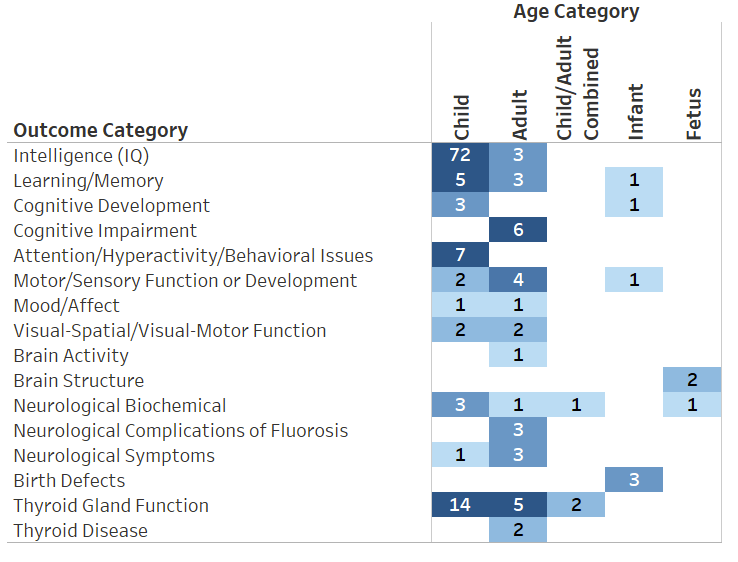
The difficult question to be asked is: can fluoride alone affect motor coordination, or is it acting synergistically to impact it? At least in humans, we frankly don’t have enough studies, as evidenced by the NTP review. See the table on the left from the 2022 draft. At the time, there were only 2 studies in children, 4 on adults, and 1 in infants (next to Motor/Sensory Function or Development).
In animal studies, as the authors note, there is not enough reporting of data on motor coordination to draw a conclusion. Nevertheless, given the significance of a possible interaction between learning/memory and motor activity/coordination, this may be answered in future research.
Fluoride & Thyroid, Oh and Autism
The NTP monograph, in drawing conclusions regarding the relationship between high levels of fluoride exposure and IQ, also includes studies regarding the impact of fluoride on thyroid function. The studies that measure 3 hormones related to thyroid function found increases, decreases, or no changes at all in relation to fluoride exposure -however, the authors of the NTP monograph indicated that these findings are not unexpected due to the interaction between the pituitary gland, the thyroid gland, and the 3 thyroid hormones. While they state that the data do not support thyroid as a mechanistic link for the effect of fluoride on neurodevelopment, they state it cannot be ruled out either (pg 742). The results, at this time, neither support nor reject the role of the thyroid as a mechanism through which fluoride impacts IQ.
This conclusion on the monograph is interesting in light of a systematic review and dose-response meta analysis published just very recently in 2024 which found association between fluoride above 2.5 mg/L and TSH (Thyroid Stimulating Hormone) concentrations [7]. Even though these findings were the result of analyzing the best quality studies, this effect remained even when removing studies from the analysis that conducted limited adjustments from their pooled analysis. This is particularly interesting for one major reason: the strengthening of a causal relationship and the role of the thyroid.
Within the context of autism, fluoride alone has not yet been implicated as a factor directly connected with autism. However, considering research that found the severity of autism symptoms associated with lower IQ [5], the connection between fluoride and aluminum and their combined connection to autism [9, 10], that thyroid dysfunction and autism are found together, a latest study on autism comorbidities and aging finding 11% prevalence of thyroid disorders among adults [19], and finally, the CHD film revealing that the very foundations of fluoride research and unethical experimentation had found that those with chronic kidney disease couldn’t excrete fluoride, a point that should be heavily considered when the same study on autism comorbidities in adults found a 25% prevalence for kidney disease, and connection between fluoride and autism comes ever closer.
Working Memory, Fluoride, and IQ
Hubermanlab’s recent podcast episode on working memory is interesting within the discussion of IQ and fluoride, and particularly because of the role of dopamine in working memory. As he shared in his review, lower dopamine is related to lower amounts of working memory, but a higher amount of dopamine is not always related to higher working memory.

Few studies in the fluoride literature examine dopamine, and the NTP monograph does review 2 studies on genetic polymorphisms. One study found that a genetic change that results in more dopamine in the brain was associated with increased urinary fluoride levels and lower IQ, while another study had opposite/no findings depending on the genotype observed (pg 743). How much is working memory, thus impacted by fluoride and dopamine, related to IQ tests in children? What about animal studies evaluating learning/memory based on tasks that require some degree of working memory? It appears this literature has a long way to go.
In regards to IQ and working memory, Pizzigallo et al. (2023) found that adults with specific learning disabilities (SLDs) who were presented The Weschler Adult Intelligence Scale, an intelligence assessment used globally, had lower scores on working memory and processing speed, something that has already been previously found with children with specific learning disabilities. An interesting research question in this study was regarding whether a four-factor structure of Intelligence, which previous research had found was appropriate for children with SLDs, would also be appropriate for adults with SLDs. These findings are particularly important within the context of working memory, because it was found at the four-factor structure of intelligence loaded higher on the working memory factor than the five factor structure of intelligence, which includes fluid reasoning [12]. What does this mean? In a nutshell, it means we are still fine tuning our understanding of intelligence and how its related to working memory and various aspects of cognitive function. The adults in this study performed better on verbal/non-verbal and reasoning tests and were close to the normative range, but scored lower than children with SLDs on may subtests, including working memory. The study did not control for the severity of the SLD in their analysis, which could account for variance in comparisons. The authors acknowledge a longitudinal study could better answer questions regarding these differences.
IQ has been found to be a predictor of academic performance as evidenced by a recent meta analysis that found that intelligence was a predictor of academic achievement by 35% [4]. Thus, the impact of fluoride on academic performance cannot be understated insofar as IQ’s predictive role in academics. Conversely, a study in 2011 on children with autism who were considered ‘higher functioning’ found that IQ was not a predictor of academic performance in their sample of thirty 9-year olds [3]. Rather, social skills was found to be a better predictor.
A fascinating study that reviews various working memory models found that working memory was associated more strongly to children’s learning of new words over and above nonverbal IQ and expressive vocabulary [20]. These were children with no history of psychiatric disorders, for context. The authors of the paper argue for teaching styles that cater to a child’s working memory profile -not necessarily expanding working memory itself, per se.
Finally, regarding IQ and job performance, a review conducted as recent as 2015 (with no pleasing follow up studies that cited them) did criticize the literature that drew conclusions regarding IQ’s predictive value on job performance based upon a fuzzy construct validity of IQ tests [6].
What should we make of these studies within the context of fluoride? I would like to see working memory in the equation somehow -if it’s not already being reflected by deficits in learning/memory tests due to impairments in working memory as a result of high fluoride exposure. Given the range of studies on the relationship between IQ and autism symptom severity [5] as well as IQ and academic performance [4], it would seem that improvements can still be made regarding how intelligence is defined. I do not say this to undermine the literature on IQ and fluoride, by no means, because it’s certainly extremely valuable, as is the present literature on IQ and its predictive performance. But rather, perhaps an understanding of fluoride’s impact on intelligence could be further expanded by additional research on fluoride’s impact on working memory as well.
Personally, I am fond of Howard Gardner’s Multiple Intelligences work -it’s no longer a theory and does have research to substantiate the work. Coupled with Growth Mindset and an attitude of life-long learning, the possibilities are quite endless really.
So long, of course, as the ever-increasing numbers of chemicals in our environment don’t detriment our cognitive capabilities and potential as we age…throwing a monkey wrench in any plans to nurture our other Intelligences.
Multiple Intelligences is probably one reason, like the heterogeneity of autism, there is some disagreement in the conceptualization of IQ, which Howard Gardner argues relies mostly on Logical-Mathematical and Visual-Spatial intelligence. Our brain is very much capable of using other regions of the brain to make up for deficits due to brain damage -how much does multiple intelligences play into that?
Nevertheless, the role that IQ plays in job performance or academics does deserve undivided attention due to ever-increasing costs upon both the education system and the healthcare system as a result of chemicals in our environment like fluoride that are having impacts on neurodevelopment, resulting in delays in learning, overworked and underpaid teachers tirelessly working to serve these communities, and parents/caregivers of those with disabilities who suffer poor mental health as a consequence of poor respite from their love-based care.
It would seem rather obvious that if we want to maximize learning potential in children and adults, whether learning is conceptualized through IQ, working memory, combinations of multiple intelligences, or all of the above, these issues need to be at the forefront of our attention.
The financial and mental health cost of further delays in resolving these matters is great.
References
- Adjuvants and Vaccines https://www.cdc.gov/vaccinesafety/concerns/adjuvants.html
- Mold, M., Umar, D., King, A., & Exley, C. (2018). Aluminium in brain tissue in autism. Journal of trace elements in medicine and biology : organ of the Society for Minerals and Trace Elements (GMS), 46, 76–82. https://doi.org/10.1016/j.jtemb.2017.11.012
- Estes, A., Rivera, V., Bryan, M., Cali, P., & Dawson, G. (2011). Discrepancies between academic achievement and intellectual ability in higher-functioning school-aged children with autism spectrum disorder. Journal of autism and developmental disorders, 41(8), 1044–1052. https://doi.org/10.1007/s10803-010-1127-3
- Lozano-Blasco, R., Quílez-Robres, A., Usán, P., Salavera, C., & Casanovas-López, R. (2022). Types of Intelligence and Academic Performance: A Systematic Review and Meta-Analysis. Journal of Intelligence, 10(4), 123. https://doi.org/10.3390/jintelligence10040123
- Denisova, K., & Lin, Z. (2023). The importance of low IQ to early diagnosis of autism. Autism research : official journal of the International Society for Autism Research, 16(1), 122–142. https://doi.org/10.1002/aur.2842
- Richardson, K., & Norgate, S. H. (2015). Does IQ Really Predict Job Performance?. Applied developmental science, 19(3), 153–169. https://doi.org/10.1080/10888691.2014.983635
- Iamandii, I., De Pasquale, L., Giannone, M. E., Veneri, F., Generali, L., Consolo, U., Birnbaum, L. S., Castenmiller, J., Halldorsson, T. I., Filippini, T., & Vinceti, M. (2024). Does fluoride exposure affect thyroid function? A systematic review and dose-response meta-analysis. Environmental research, 242, 117759. https://doi.org/10.1016/j.envres.2023.117759
- Kupnicka, P., Listos, J., Tarnowski, M., Kolasa-Wołosiuk, A., Wąsik, A., Łukomska, A., Barczak, K., Gutowska, I., Chlubek, D., & Baranowska-Bosiacka, I. (2020). Fluoride Affects Dopamine Metabolism and Causes Changes in the Expression of Dopamine Receptors (D1R and D2R) in Chosen Brain Structures of Morphine-Dependent Rats. International journal of molecular sciences, 21(7), 2361. https://doi.org/10.3390/ijms21072361
- Strunecka, A., Blaylock, R. L., Patocka, J., & Strunecky, O. (2018). Immunoexcitotoxicity as the central mechanism of etiopathology and treatment of autism spectrum disorders: A possible role of fluoride and aluminum. Surgical neurology international, 9, 74. https://doi.org/10.4103/sni.sni_407_17
- Johnston, N. R., & Strobel, S. A. (2020). Principles of fluoride toxicity and the cellular response: a review. Archives of toxicology, 94(4), 1051–1069. https://doi.org/10.1007/s00204-020-02687-5
- Fluoridation, Fluoridation, Fluoridation: Science (not fluoride) on trial. Dr Christopher Exley. Jan 15, 2024
- Pizzigallo, E., Cornoldi, C., Buono, S., Città, S., Viola, F., & Toffalini, E. (2023). The Intellectual Profile of Adults with Specific Learning Disabilities. Journal of Intelligence, 11(12), 223. https://doi.org/10.3390/jintelligence11120223
- Aluminum – Vaccine Risk Statement (VRS). https://physiciansforinformedconsent.org/aluminum-in-vaccines/
- Aluminum Snow: Lab Test Confirmed https://www.youtube.com/watch?si=eU2fTjvdPme-os4k&embeds_referring_euri=https%3A%2F%2Fwww.geoengineeringwatch.org%2F&source_ve_path=MTY0NTA2LDEzOTExNywzNjg0MiwxNjQ5OSwyODY2NCwxNjQ1MDY&feature=emb_share&v=-KJqf8MU-2U
- Water Fluoridation Again: Clearer, deeper thinking needed on fluoride toxicity. Dr Christopher Exley. Oct 9, 2023
- Khan, F. Y., Kabiraj, G., Ahmed, M. A., Adam, M., Mannuru, S. P., Ramesh, V., Shahzad, A., Chaduvula, P., & Khan, S. (2022). A Systematic Review of the Link Between Autism Spectrum Disorder and Acetaminophen: A Mystery to Resolve. Cureus, 14(7), e26995. https://doi.org/10.7759/cureus.26995
- Abd Wahil, M. S., Ja’afar, M. H., & Md Isa, Z. (2023). Urinary aluminium and its association with autism spectrum disorder in urban preschool children in Malaysia. PeerJ, 11, e15132. https://doi.org/10.7717/peerj.15132
- Mohd Nordin, A., Ismail, J., & Kamal Nor, N. (2021). Motor Development in Children With Autism Spectrum Disorder. Frontiers in pediatrics, 9, 598276. https://doi.org/10.3389/fped.2021.598276
- Miot, S., Akbaraly, T., Michelon, C., Couderc, S., Crepiat, S., Loubersac, J., Picot, M. C., Pernon, É., Gonnier, V., Jeandel, C., Blain, H., & Baghdadli, A. (2019). Comorbidity Burden in Adults With Autism Spectrum Disorders and Intellectual Disabilities-A Report From the EFAAR (Frailty Assessment in Ageing Adults With Autism Spectrum and Intellectual Disabilities) Study. Frontiers in psychiatry, 10, 617. https://doi.org/10.3389/fpsyt.2019.00617
- Gray, S. I., Levy, R., Alt, M., Hogan, T. P., & Cowan, N. (2022). Working Memory Predicts New Word Learning Over and Above Existing Vocabulary and Nonverbal IQ. Journal of speech, language, and hearing research : JSLHR, 65(3), 1044–1069. https://doi.org/10.1044/2021_JSLHR-21-00397
 The Causes of Autism